
For many Indian businesses, international expansion begins with a seemingly simple instruction: “Let’s incorporate a company overseas.” Incorporation, however, is usually the easy part. The more important decisions concern what happens before and after incorporation: what the overseas company will actually do, how it will be funded, how it will transact with India, where profits should arise, what continuing compliances will follow and, eventually, how profits or capital may return to India.
Start with the business model, not the jurisdiction
Consider an Indian technology, consulting, manufacturing or services company planning to enter the United States, United Kingdom, Europe, the Middle East or another international market. Its overseas entity could perform very different functions: it might develop customers for the Indian company, contract directly with customers, employ its own teams, own intellectual property, or eventually become a substantial operating company in its own right.
Each model creates different commercial, financial, regulatory and tax consequences. Before choosing the structure, management should consider who will contract with customers, where employees and key decision-makers will be located, who will own intellectual property, which company will bear market, product and credit risks, and which entity should economically earn the resulting profit.
A structure should follow the commercial model - rather than requiring the commercial model to be reconstructed later merely to justify a structure established without sufficient planning.
Overseas investment brings FEMA and ODI into the conversation
For an Indian business investing outside India, international expansion also enters India's foreign-exchange and overseas-investment framework. The current framework includes the Foreign Exchange Management (Overseas Investment) Rules, 2022 and the Foreign Exchange Management (Overseas Investment) Regulations, 2022. The Rules provide, among other things, that overseas investment is generally to be made in a foreign entity engaged in a bona fide business activity, subject to the applicable conditions and limits.
The regulatory analysis should therefore begin before funds leave India. Proposed ownership, the nature of the foreign business, investment structure, funding requirements and expected future transactions should be considered together. ODI should not be treated merely as a banking formality attached to an outward remittance; it is part of the structure of the international investment itself.
How much money should actually be sent overseas?
Once a foreign entity has been established, businesses frequently focus on the mechanics of sending money abroad. A better question is: how much capital does this business genuinely require, and in what form?
Management should consider establishment costs, anticipated operating losses during the initial period, working-capital requirements, capital expenditure and the possibility of future expansion. Sending too little may result in repeated funding requirements. Sending substantially more than the business requires can leave capital overseas without a clear immediate commercial purpose.
Funding therefore deserves its own strategy, considered in the context of the business plan, applicable FEMA/ODI requirements, taxation, transfer pricing and expected cash flows.
The Indian parent and overseas subsidiary are separate enterprises
Once incorporated, the Indian parent and its overseas subsidiary are legally separate entities - even if management continues to think of them as one business. Transactions between them therefore need to be identified, priced, documented and accounted for appropriately.
The Indian company may provide software development, technical or management services, finance and HR support, marketing assistance, employees, intellectual property, funding, guarantees or centrally incurred services and expenses. The overseas entity may likewise provide services or incur expenditure for the Indian company. One inter-company transaction can therefore interact with several regulatory frameworks at the same time.
Transfer pricing begins when the relationship begins
Where transactions take place between associated enterprises, India's transfer-pricing provisions may become relevant. Section 92 of the Income-tax Act, 1961 provides that income arising from an international transaction is to be computed having regard to the arm's-length price; it also addresses expenses or interest arising from an international transaction and certain cost-allocation or contribution arrangements.
The practical implication is important: transfer pricing should not begin at year-end when Form 3CEB is being prepared. It should begin when the commercial relationship between India and the overseas company is designed.
Management should understand what each company does, what assets it employs, what risks it assumes, what value it contributes and why its resulting remuneration makes commercial sense. Documentation should follow the business reality - not attempt to create that reality afterwards.
Agreements, invoices and actual conduct should tell the same story
Suppose an Indian parent provides management services to its overseas subsidiary. Raising a management-fee invoice establishes that an invoice exists. It does not, by itself, explain what services were actually provided, who provided them, why the overseas company required them, what benefit was expected, how the charge was calculated or why the resulting price was appropriate.
Similarly, an inter-company agreement prepared after the financial year cannot by itself change how the businesses actually operated throughout that year. A stronger arrangement creates consistency across commercial reality, agreement, actual conduct, invoicing, accounting and transfer-pricing documentation.
Form 3CEB is reporting - not the beginning of the process
The Income Tax Department's transfer-pricing guidance states that a person entering into an international transaction or specified domestic transaction is required to obtain an accountant's report in the prescribed form; the prescribed form is Form 3CEB. But the reporting stage should not be the first occasion on which the business examines its inter-company arrangements.
By that stage, the transactions have ordinarily already occurred. Businesses operating internationally should therefore identify related-party transactions during the year, establish the commercial rationale, maintain relevant agreements and evidence, and consider the transfer-pricing methodology contemporaneously.
International tax has to be considered from both sides of the border
An international transaction rarely belongs exclusively to one country's tax system. A payment received by India may represent income in India while simultaneously creating withholding-tax considerations overseas. Services performed across borders can create questions concerning taxable presence. Domestic tax law may interact with an applicable Double Taxation Avoidance Agreement. Transfer pricing can influence how income is attributed between related enterprises.
The question should therefore not simply be “What is the Indian tax?” A more useful question is: “What is the combined commercial, tax and regulatory consequence across the jurisdictions involved?”


International expansion changes the finance function
A company can become international much faster than its finance function does. Management may suddenly be dealing with multiple currencies, different accounting systems, foreign bank accounts, local advisers, inter-company balances, different reporting requirements and group consolidation.
Inter-company balances should reconcile. Income recorded by one group company should correspond appropriately with expenditure or balances recorded by the other. Capital contributions should agree with banking and corporate records. Differences should be investigated while information remains readily available rather than accumulating over several financial years.
International expansion therefore requires the finance function to expand internationally as well.
Plan how money may come back before deciding how it goes out
Businesses understandably spend considerable time determining how to fund an overseas operation. Less attention is sometimes given to the reverse journey. If the overseas business succeeds, how will value ultimately return to India?
Depending upon the circumstances, future cash flows might involve dividends, repayment of funding, genuine payments for services or intellectual property, capital transactions or eventual exit proceeds. Each route can have different commercial, tax, withholding, transfer-pricing and regulatory consequences.
The objective is not to choose a repatriation mechanism years in advance. It is to avoid creating an initial structure that unnecessarily restricts future choices.
Compliance should be designed - not discovered
International expansion creates continuing obligations. These may arise under India's FEMA/ODI framework, Indian income-tax and transfer-pricing provisions, financial reporting requirements and the corporate, regulatory and tax laws of the overseas jurisdiction.
A compliance framework should therefore be established when the international business begins. The objective should be to move from deadline-driven compliance to transaction-driven compliance: every significant cross-border investment, funding arrangement, inter-company agreement, restructuring or movement of funds should trigger consideration of the associated regulatory and tax consequences.
Framework
The question to ask before incorporating
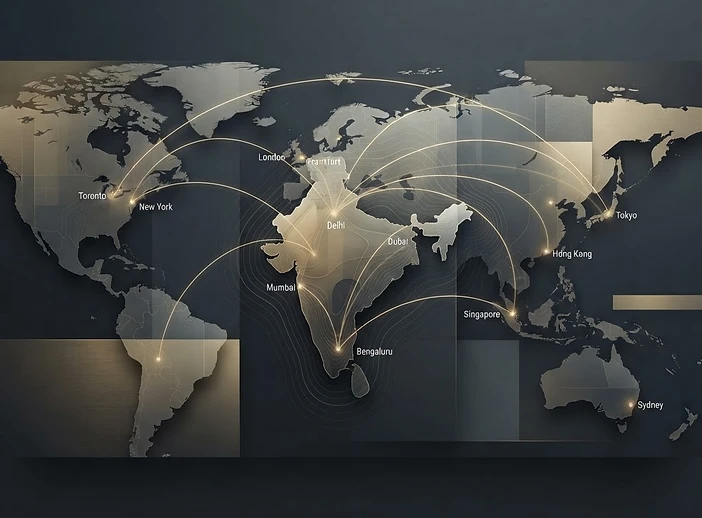
International expansion should not begin with a certificate of incorporation. It should begin with a map.
Looking at these elements together can help management understand not merely whether an overseas structure can be established, but whether that structure can continue to work as the business grows.
Perspective
See further
The best time to understand the consequences of international expansion is before the first investment is made, before the first inter-company agreement is signed and before the first cross-border invoice is raised.
At Puneet Puri & Company, we approach international expansion across the transaction - connecting business structure, FEMA and ODI, international taxation, transfer pricing, financial reporting and continuing compliance.
Official sources
References & regulatory framework
Important publication note (8 July 2026): India's Income-tax Act, 2025 is scheduled to come into force from 1 April 2026 and the Income Tax Department has published 2026 forms/guidance. Before publishing any section/form number on the live website, Puneet Puri & Company should verify the citation against the law and form applicable to the relevant period. The article intentionally focuses on enduring principles where possible.
Disclaimer: This article is intended for general informational purposes and does not constitute tax, legal, investment or regulatory advice. The application of Indian and overseas laws depends on the facts and circumstances of each transaction and the law applicable at the relevant time.